

22 October 2026
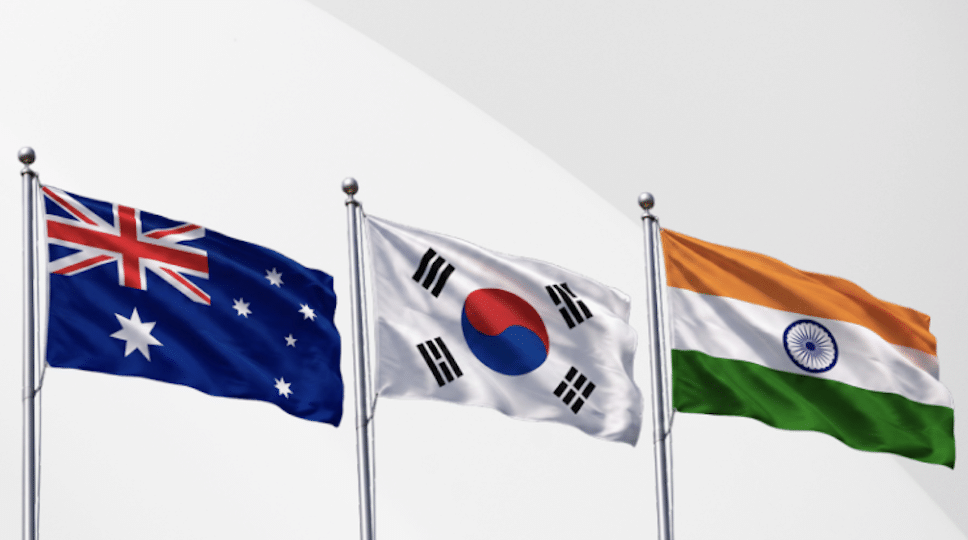
An Australia, India, Republic of Korea (ROK) partnership represents an important strategic opportunity for the region as the rules-based order erodes, a report produced by the Australia India Institute at the University of Melbourne has found.
Produced in collaboration with the Asia-Pacific Leadership Network (APLN) and Jawaharlal Nehru University (JNU), and generously funded by the Korea Foundation, The Strategic Imperative for an Australia, India, South Korea Partnership was launched today (October 22) at the Sejong Institute in Seoul.
The report is the first to examine the possibility of this strategic partnership. It argues that by combining Australia’s regional engagement and diplomatic networks, India’s strategic and manufacturing weight as well as its influence in the Global South, and the ROK’s technological and industrial capabilities, the trilateral could emerge as an influential pillar of Indo-Pacific resilience and prosperity.
It emphasies the importance of reshaping a regional order which is Asian-led in the face of regional instability, as opposed to reflecting externally driven norms shaped by the West.
The Strategic Imperative for an Australia, India, South Korea Partnership is the result of more than eighty interviews with government, think tank, diplomatic, academic, and industry representatives, as well as current and former uniformed personnel in New Delhi, Seoul, Melbourne and online.
QUOTE FROM PROF MICHAEL WESLEY, DISTINGUISHED FELLOW OF THE AUSTRALIA INDIA INSTITUTE AND DEPUTY VICE CHANCELLOR (GLOBAL, CULTURE AND ENGAGEMENT), UNIVERSITY OF MELBOURNE:
“The Indo-Pacific’s future will be shaped by how countries respond to challenges and work together. Australia, India and the Republic of Korea are well placed to deepen cooperation in ways that strengthen regional stability, resilience and prosperity.
“What makes this report important is that it moves the conversation from aspiration to action. By identifying where interests align and where collaboration can deliver tangible outcomes, it provides a practical framework for building stronger regional partnerships and advancing shared regional goals.”
QUOTE FROM DR JUNG-SUP KIM, PRESIDENT OF THE SEJONG INSTITUTE
“Asia’s middle powers have both the capacity and the responsibility to contribute more to the region’s security and prosperity. Korea, Australia and India can develop a new model of cooperation that complements existing alliances and partnerships. Its success should be measured by the benefits it brings to our people and the opportunities it creates for the wider Indo-Pacific.
“In an unsettled world, we need the imagination to look beyond familiar partnerships and the pragmatism to make new ones work. What will bind our three countries is what we can actually achieve together. Our roundtable will build on this report and take its ideas further, focusing on practical initiatives that draw on our complementary strengths and can be extended across the region.”
Media Requests:
Laura Hooper, Communications Manager, Australia India Institute: laura.hooper@unimelb.edu.au