

By CEO Lisa Singh
The date of 14 May did not go unnoticed this year in Fiji. The day itself is both the 147th Girmit Day and the 39th anniversary of the 1987 Fiji coup – both defining moments in Fiji’s history.
Girmit Day commemorates when Indian indentured labourers (known as girmityas) first arrived in Fiji in 1879, as part of the British indentured labour system that brought approximately 60,000 Indians on ships from India to Fiji to work in harsh conditions in the colony’s sugar plantations. A practice used across the Empire, it was regarded as a form of servitude and was finally abolished in 1920.
On 14 May 1987, then-Colonel Sitiveni Rabuka led his second military coup to overthrow the newly elected coalition Fiji government through fear of Indo-Fijian dominance. The electoral loss of the indigenous Fijian-dominated Alliance Party provided a catalyst for the coup, seen as an act to “protect Fijian rights” and bolstered by the ultra-nationalist Taukei Movement. It divided the country down ethnic lines and was met with international condemnation. Australia, New Zealand, India, the United States, the United Kingdom and others moved quickly to dissociate themselves from the new Fijian republic.
Since that time, Rabuka, now again Prime Minister since the 2022 election, has made efforts for reconciliation and national unity on each Girmit Day, including declaring the day itself a public holiday. Rabuka delivered the most memorable address soon after his election – a powerful “confession” on Girmit Dayat a Fijian Methodist church that spoke of forgiveness. Delivered not as Prime Minister but as a personal acknowledgement –and on behalf of those who took part in the 1987 military coup – he admitted the wrongdoings that hurt the people of Fiji, “particularly the Indo-Fijian community, and among them the sons and daughters, grandsons and granddaughters of those who were indentured as labourers from India”.
“We confess that we have wronged you, we confess that many eventually left our shores, those of you that remain and slog on with us and have brought some restoration in our relationships over the past few years, I thank you. I thank the community leaders who have worked tirelessly to bring to the communities of Indigenous Fijians and Indo-Fijians together.”
This year, the tone of Rabuka’s address was similarly heartfelt, describing the contributions of Indo-Fijians in laying the foundations of Fiji’s agricultural economy and acknowledging the displacement, sacrifices and conditions of the girmityas as narak, Sanskrit for “living hell”.
Girmit is a word that evolved from the “agreement” that Indians signed as part of the British indenture system, established following the abolition of slavery to replace enslaved labour. Despite being offered opportunity, the reality was far from it. The arkathis – British recruiters – tricked Indians into signing the agreement on the false promise of decent pay and conditions to work on a nearby island.
On 14 May 1879, the Leonidas, a labour transport ship, arrived in Levuka carrying the first group of indentured labourers from India after a harrowing 72-day voyage from Calcutta. Of the 498 men, women and children on board, 17 died before arriving in Fiji due to the outbreak of cholera and smallpox.
The tens of thousands transported to Fiji under contract to do five years of servitude mainly worked for the Australian Colonial Sugar Refining Company (CSR), which controlled a major stake in the Fiji sugar industry. Experiencing severe hardship, they suffered slavery-like working conditions, disease and overcrowded living conditions.
Despite being offered a free return passage to India at the end of the indenture period, the promise was not kept, and they instead would have to earn it through a further five years with the sugar estates. A majority chose to stay and make Fiji their new home where they developed their own unique Indian culture. The British did not consult the indigenous Fijians on the arrival of new Indian migrants with whom they would be made to co-habitate. Yet many iTaukei villagers would come to risk their lives to save Indians when ships like the Syria were wrecked on reefs, and the friendships of indigenous Fijians and Indo-Fijians have endured for decades.
In total, nearly two million Girmityas were sent across a range of European colonies from Mauritius, South Africa to Malaysia and the West Indies with the same experiences of harsh labour conditions, the trauma of separation and years of hardship.
Several ships followed the Leonidas, including the SS Viriwa, which carried my great-grandfather Laxman from India to Fiji in 1902 with 717 other indentured passengers. He was only 19. A copy of his emigration pass signed by the surgeon superintendent certified him as “permitted to proceed as in a fit state of health to undertake the voyage to Fiji”. The ship would have first sailed along the Hooghly River in Calcutta out into the Bay of Bengal and then further south into the Pacific Ocean on the long voyage to Fiji. He would never come back to India and his son would go on to become a politician in Fiji. Like so many descendants of girmityas, his descendants would help build a modern Fiji after colonialism while some would leave Fiji to start new lives across the world.
The Girmit story is one of courage, survival, sacrifice and endurance. It has left a lasting, heartfelt impact for the descendants who seek to trace their ancestors and understand their Indo–Fijian heritage. The fact of Girmit Day and the anniversary of the 1987 coup falling on the same date – marked this year with words of healing from Fiji’s prime minister – highlights how these two ethnic groups can build a sense of belonging for all the people of Fiji.
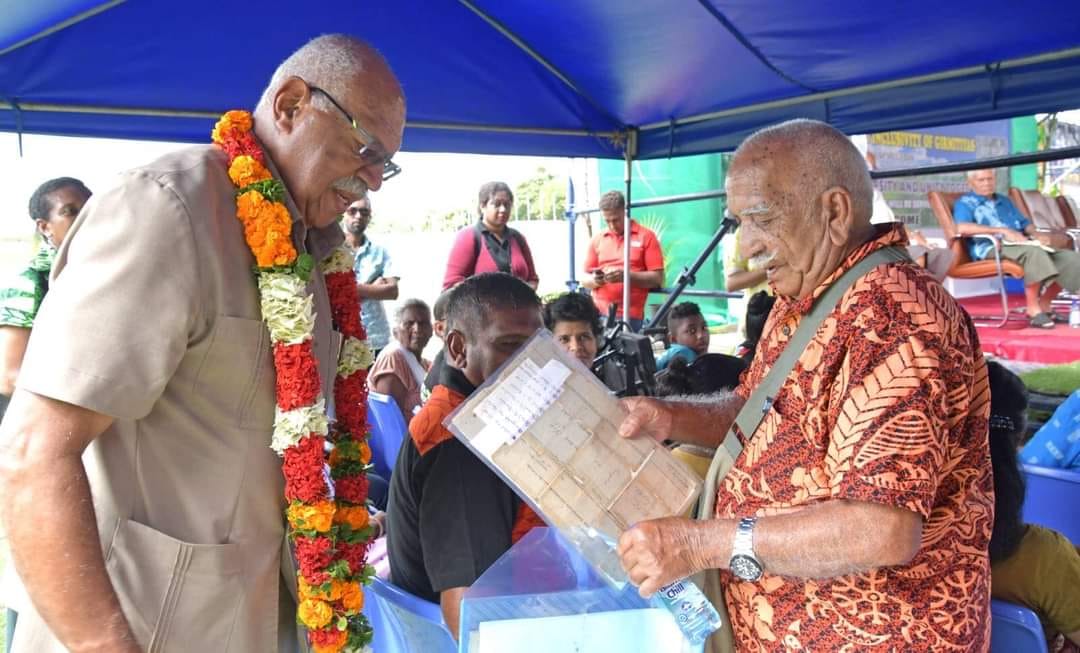
This article was originally published in the Lowy Interpreter. Image: Fiji Prime Minister Sitiveni Rabuka, left, with descendants of Girmityas in 2024 (Prime Minister Sitiveni Rabuka/Facebook)