


By Nitin Jaiswal, Founder, Agetech Leadership Labs
In 1956, when the United States passed the Federal Aid Highway Act, no one was debating whether Americans would own cars. That question had already been answered by millions of vehicles moving on roads built for horses. The Act was not a prediction. It was an acknowledgment that a new reality had arrived, and that the infrastructure to serve it had not yet been built.
The same recognition is now overdue for ageing.
Institutions designed for 60-year lives are being asked to support 90-year lives. By 2050, more than one billion people in the Indo-Pacific will be over 60. Pension systems, healthcare, housing, employment frameworks, cities, financial products, and care systems were built for a world that no longer exists. Ageing is therefore not only a demographic issue; it is an infrastructure issue.
It is often framed as a health challenge or a fiscal burden, and in part that is true. But if people are living longer, the larger question is how to help those longer lives remain healthy, financially secure, purposeful, and connected. That requires treating longevity not as a cost centre, but as an economy in its own right, just as the digital and green economies became organising frameworks for investment, innovation, and institutional design. At AgeTech Leadership Labs, we call this the Longevity Economy.
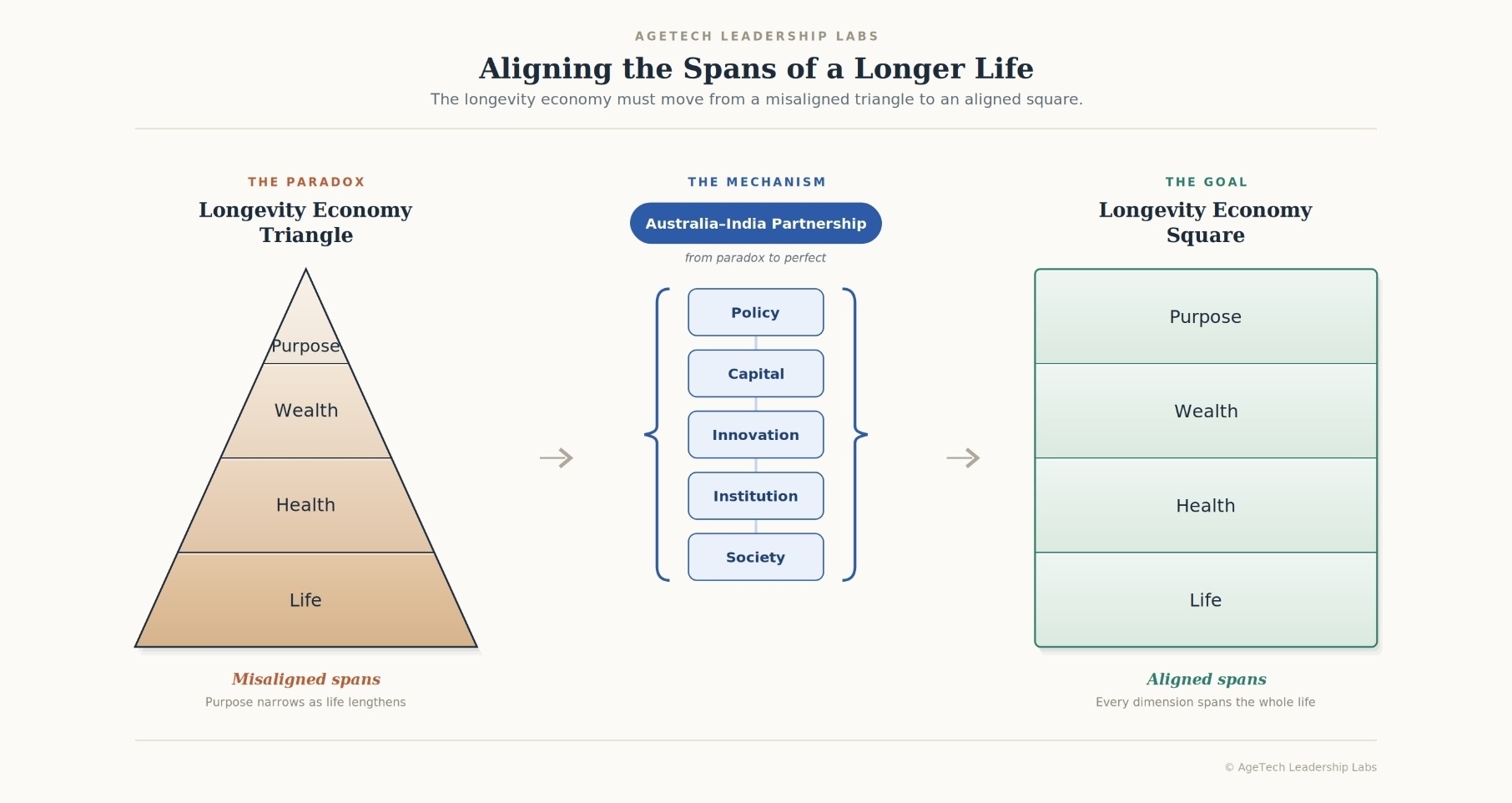
Every economy requires infrastructure. The Longevity Economy will need pension architecture, preventive health systems, care models, age-friendly housing, workforce pathways, lifelong learning, insurance products, and digital public infrastructure. That infrastructure does not yet exist at the scale required. This is the Infrastructure-Lifespan Mismatch: human lifespan has extended faster than the systems designed to support it. People are not failing the system; the system was designed for a different lifespan.
The asymmetry that matters
Australia and India enter the Longevity Economy from different starting points, and this is precisely what makes them complementary. Australia is already inside the ageing transition; its pensions, aged-care sector, health services, housing, and workforce planning are all being reshaped by longer lives. India still has a valuable window before pressure becomes nationally acute, though that window is narrowing: it has around 140 million people over 60 today, expected to exceed 320 million by 2050.
Countries already experiencing ageing have lessons, capital, and policy experience. Countries still approaching the transition have scale, time, and the ability to design before crisis forces reactive reform. The question is whether the relationship can move from alignment to architecture from shared interests to shared institution-building. Longevity infrastructure offers precisely that opportunity.
What Australia can offer
Australia’s most exportable policy innovation is not only its minerals sector or its universities. It is also its superannuation system. Introduced in 1992 and now approaching a 12 per cent mandatory contribution rate, it has created one of the world’s largest pension pools, with more than A$4 trillion in assets patient capital of the kind the Longevity Economy requires, since aged-care facilities, retirement housing, and preventive health systems are not short-cycle investments.
Australia’s aged-care experience also offers an important caution. The Royal Commission into Aged Care Quality and Safety documented systemic failures across workforce, oversight, care delivery, and institutional design. The lesson is clear: aged-care infrastructure cannot be built reactively. By the time demographic pressure makes failure politically undeniable, the cost of retrofitting is far higher than designing well from the start. India can learn from what Australia built, what worked, what failed, and what had to be reformed without copying the model wholesale.
What India can offer
India brings time, scale, cost innovation, and digital public infrastructure. Aadhaar and UPI are among the world’s most sophisticated population-scale systems; UPI processed more than 117 billion transactions in 2024, showing India can build at scale when the need is clear. Its pharmaceutical sector delivers complex medicines at globally relevant prices, Ayushman Bharat demonstrates healthcare delivery at population scale, and the National Programme for Health Care of the Elderly provides an early policy foundation.
India can also design longevity infrastructure at developing-economy price points. Most Indo-Pacific countries cannot import expensive advanced-economy models of aged care, retirement housing, or insurance; they need solutions that are affordable, scalable, and digitally enabled. For Australia, India offers not only a market but the price-performance discipline needed to turn domestic solutions into models that can travel.
Why this matters now
Most of the Indo-Pacific including Indonesia, Vietnam, the Philippines, Thailand, and many smaller economies will face ageing challenges similar to India’s, but with fewer of India’s capabilities. If Australia and India can develop longevity infrastructure at India’s price-performance level, supported by Australian policy and capital experience, the model could travel well beyond the bilateral relationship. That would make the partnership not merely cooperative, but standard-setting.
Five priorities for action
- Create a bilateral longevity research consortium, convened through the Australia India Institute, to produce joint policy work on pensions, aged care, healthspan investment, workforce, housing, and longevity measurement.
- Develop a GIFT City investment vehicle to channel Australian institutional capital into Indian longevity infrastructure.
- Transfer superannuation knowledge through a structured exchange between the Australian Treasury, APRA, and Indian counterparts including PFRDA.
- Build a joint AgeTech innovation pipeline linking research institutions, technology firms, healthcare providers, and capital.
- Establish a Northeast India care training hub aligned with the needs of Australia, Japan, Singapore, and the Gulf.
A defining agenda
Australia and India have built a strategic partnership few would have predicted twenty years ago. The next step is to give that foundation a defining forward-looking purpose. Longevity infrastructure can be that purpose: a challenge both countries face, an opportunity both can shape, and a field where their strengths are genuinely complementary. Australia brings hard-won lessons; India still has a window to design ahead of pressure. Together, they can build what neither can build alone.
The world is aging but it has not yet built the infrastructure for longer lives. Australia and India are well placed to help change that, for themselves, for the Indo-Pacific, and for the world.