

By Academic Fellow Samuel Bashfield and Senior Projects and Policy Manager and Research Fellow Grace Corcoran
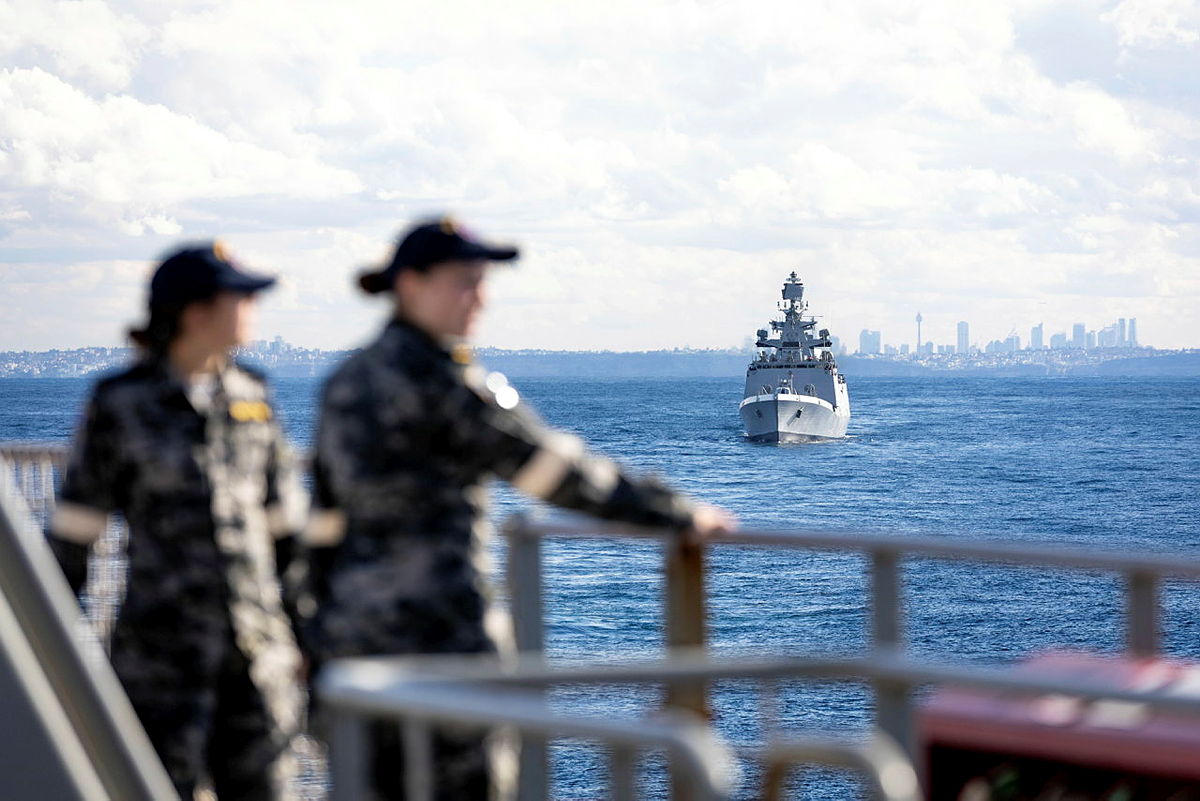
A generation ago, Australia and India had little to say to each other on defence. Today, the two are talking about almost everything.
The risk for Canberra is not whether the partnership will deepen, but whether Australia will move quickly enough to avoid missing the scale of opportunity emerging in India.
At the inaugural Australia-India Defence Ministers’ Dialogue in October last year, the two governments committed to an annual defence ministerial dialogue, deeper joint exercises across numerous domains, highlighted closer co-operation on information sharing, and announced the first Indian position at the Australian Defence Force Academy. The two also signed a mutual submarine rescue arrangement and India offered Indian shipyards for the maintenance, repair and overhaul of Royal Australian Navy ships deployed in the Indian Ocean.
Defence partnerships do not move this far, this fast, by accident. They move because the strategic logic demands it.
Australia’s 2026 National Defence Strategy, released last month, names the Northeast Indian Ocean as part of Australia’s primary area of military interest, the geography against which the Australian Defence Force structures and postures itself. It states India is a ‘top-tier security partner’ and the most ‘important defence partner’ in that region.
The reasoning is clear. China’s military build-up, described in the strategy as the largest in the world today, is increasingly visible in the Indian Ocean. The People’s Liberation Army Navy’s submarines patrol the region; Chinese research vessels survey its seabed; Beijing’s strategic reach extends well beyond the Malacca Strait. Australia’s trade routes run through these waters, and both countries are resident maritime powers. This shared geography, and shared threat, creates a set of practical opportunities for deeper co-operation. Maritime security is the obvious one, and the most developed. Australian and Indian maritime patrol aircraft now conduct collaborative anti-submarine warfare activities. The two countries are progressing an agreement on air-to-air refuelling. The Joint Maritime Security Collaboration Roadmap, discussed at the October meeting, points towards more sustained co-operation in the maritime domain across the region.
Cyber security is a less developed area of co-ordination, but one with significant potential. India is the most targeted country for cyber-attacks in the world, while the Australian Signals Directorate notes that one cyber-attack alert is received in Australia every six minutes. Both countries face persistent intrusions against critical infrastructure; both have invested heavily in sovereign cyber capability: Australia through REDSPICE, India through its expanding cyber command structures.
Information sharing on threats and techniques, joint exercises, and co-ordination on submarine cable security are all areas where two technically capable democracies could do considerably more than they currently do.
Defence industry is the most consequential opportunity, and the most complex. India’s defence-industrial sector is no longer the procurement bureaucracy of a decade ago. It is a growing ecosystem of public shipyards, large manufacturers, defence start-ups, and a deliberate state policy, Make in India, that centres technology transfer, local production, and indigenisation as conditions of access. For Australian firms, this is unfamiliar terrain. Australian defence industry is small, export-oriented, and generally accustomed to selling finished capability rather than co-developing it inside someone else’s industrial policy.
A top-down approach from governments will be needed here to meet the unrealised potential.
As stated in a recent Australia India Institute report, this should be done ‘by supporting smaller Australian companies to engage and by the Indian government providing greater clarity on where it perceives the opportunities to lie. They may also need to demonstrate commitment by procuring defence products made by Australia-India joint ventures.’
However, India’s longstanding policy of strategic autonomy also continues to shape its external partnerships. Russia remains a significant, though declining, supplier of defence equipment, and New Delhi has not aligned with Western sanctions on Russia following the war in Ukraine. India also maintains substantive ties with Iran. These relationships affect the scope of intelligence sharing, the transfer of sensitive technologies, and the broader political context in which the partnership operates, particularly regarding Canberra’s relations with Washington and London.
Yet, while Australia weighs these concerns, others are not waiting. Countries with more existential threats from Russia have put these concerns aside and make the most of the India opportunity.
France is now India’s second-largest arms supplier after Russia, accounting for roughly 33 per cent of India’s arms imports. Between 2020 and 2024, India received almost double the French defence exports compared to the combined share delivered to the rest of the EU. For example, in April last year, France signed a $7.5bn intergovernmental agreement to supply 26 Dassault Rafale Marine fighters to the Indian Navy.
This co-operation is also not limited to procurement. Under the India-France Defence Industrial Roadmap, both countries are integrating their defence innovation ecosystems, bringing together investors, incubators, start-ups and research institutions. The emphasis is on long-term co-development and industrial partnership, rather than transactional sales.
Germany is following a similar path. In April this year, Germany and India inked a Defence Industrial Roadmap and the two countries are expected to finalise an agreement worth roughly $8bn for six advanced submarines, to be built at India’s Mazagon Dock Shipbuilders Limited in partnership with Germany’s Thyssenkrupp Marine Systems. This builds on a broader shift in Berlin’s approach. Over the past year, Germany has eased export controls for India, particularly in high-value areas such as electronic warfare, sensors and avionics, signalling a willingness to support deeper industrial integration.
This aligns with Germany’s wider strategic recalibration. Following Russia’s invasion of Ukraine and growing uncertainty around US security commitments, Berlin has prioritised diversifying its defence partnerships, with a clear focus on the Indo-Pacific. Its 2024 “Focus on India” policy paper identifies India as a priority partner for joint production, industrial co-operation and co-ordinated responses to regional instability. With Germany’s defence spending reaching $US88bn in 2024, making it the world’s fourth-largest military spender, Berlin is positioning itself as a central hub for European defence production, increasingly reliant on partnerships with large manufacturing bases like India.
Neither Paris nor Berlin appears unduly troubled by Delhi’s continuing relationships with Moscow or Tehran. Both have accepted the terms of India’s industrial framework and moved early to secure long-term positions within it.
Whether this model is appropriate for Australia is a question that requires careful consideration.
But the scale and pace of industrial activity underway in India is becoming increasingly difficult to ignore.
The strategic case is obvious. Geography has decided it. The National Defence Strategy has formalised it. The ministers have signed it. China’s expanding presence in the Indian Ocean ensures it will not reverse.
The implementation question is what remains. Australia has real comparative advantages in maritime security, cyber and defence industry, opportunities aligned with Indian priorities, but also legitimate concerns about Delhi’s external partnerships and the demands of its industrial policy. Neither will disappear.
What should not be in doubt is the trajectory: strategic windows narrow, industrial ecosystems are difficult to enter once set. If Australia does not move with similar urgency, it risks missing opportunities others are already securing.
This article was originally published in ‘The Australian’.This image is sourced from the Department of Defence.
